What good is proof if you might not survive the consequences before you get it?
Have you ever had one of those days where a nice young gentleman comes up to you at the bus station and strikes up a pleasant conversation with you, but something just feels off about it? He’s just a little too nice. Just a little too friendly. Just a little too nosey.
What if you notice him nod to the driver of an unmarked van and instantly decide to board the bus that is arriving—even though it isn’t your usual line? What if he follows you? What if you take him on a crazy adventure of a ride that lands you both in front of the Pentagon?
Has that ever happened to you?
No?
So, it’s just me?
Okay…forget I said anything...
Before we get into this month’s rather uncomfortable question, I want to take a moment to say: Thank You!
The Kofler Files is still a young publication, and every person who has chosen to subscribe, read a File, open a Dispatch, or spend a few minutes thinking about these characters means more to me than you probably realize.
You’re here while these stories are still taking shape.
And I love that!
Writing The War Within series isn’t simply about deciding what happens to Jenny. It’s about asking why she makes the choices she does—and whether we would make different choices if we were standing where she was standing.
A little something for being here early
Since you’re here while these stories are still taking shape, I want to give you something that isn’t available to everyone.
Downward Spiral is the exclusive prologue to Roots of Obsession, and it’s available only to subscribed members of The Kofler Files.
It’s an early glimpse into Jenny’s world—and into the events that set the stage for The War Within.
If you’re not subscribed to The Kofler Files yet, click the Subscribe button below, and you’ll get instant access to Downward Spiral, the exclusive prologue to Roots of Obsession.
Now back to the uncomfortable question
This week, while editing a scene between Yanis and Jenny, I started thinking about the legal and ethical implications of Jenny’s actions.
For some context, one of the guards has been very jovial and friendly with Jenny. He side-bumps her arm, puts his hand on her shoulder, and pats her back when he is near her. But there is nothing about any individual interaction that would necessarily set off an alarm.
A hand on her shoulder could be a friendly gesture. A pat on the back could be brushed off as harmless. Even the frequency with which he seeks her out could be explained away.
That’s part of what makes it difficult.
From Jenny’s perspective, it’s the pattern that bothers her. The repeated contact. The fact that he seems to find reasons to be near her. The way his attention toward her has been escalating.
And then there’s the invitation from the previous evening to join him in watching the game—which somehow turned into the question:
“Would anyone even look for you if you left?”
That question, in particular, sets off every alarm she has.
Jenny has learned that someone looking to exploit another person doesn’t necessarily announce themselves as a threat. They can test boundaries gradually. They can ask questions that seem innocent in isolation. They can create interactions that are easy to dismiss individually while watching to see how someone responds.
That’s what Jenny thinks she’s seeing.
And the timing makes it worse.
The following day is the beginning of the weekend shift—a period Jenny considers particularly high-risk for herself. Whatever is happening, she doesn’t believe she has the luxury of waiting to find out.
Based on her observations, intuition, and experience, she suspects the guard may be a scout for traffickers.
But suspicion—and the presence of a trafficking ring alone—are not proof.
That’s where things get complicated. Here's the excerpt from the scene in Roots of Obsession where Jenny and Yanis discuss engineering a situation that could get the guard transferred or fired.
Yanis’ POV
“You have a problem,” I said. “Want me to solve it?”
“No. I refuse to owe you anything,” she said.
I waited. Despite what she said, I could see her thinking about it.
“I will make an exchange of equal value on the condition that we owe each other nothing once our objectives are met,” she finally replied.
“What do you have of value?” I asked, now intrigued.
She’s making me an offer.
“Theoretically, you might be in need of certain key items, just as I am in need of the removal of a certain individual’s access to me,” she continued. “You get what you need. I get what I want. We split the risk.”
“Convince me.” I leaned back and waited.
“I cannot say directly, but the individual in question carries certain items of possible interest. After lunch, the door to the outdoor courtyard will be opened. The Russians, the Roma, and my parents and I will gather there. You should bring the sick kid for some sunshine.”
“How is this of value?”
“So impatient.” Jenny shook her head. “The individual will remove his uniform shirt, finish his tea, and head to the bathroom. There, he always removes his belt and hangs it over the door. The items in question are on the belt. The rest is up to you.”
“Your information is worthless to me. Whatever you think I need, you’re wrong. And your plan is stupid.” It was a bald-faced lie, but I couldn’t have her thinking we were on the same level.
“Your loss,” she shrugged. “I don’t actually need your help. This individual will be gone before the weekend, regardless. I just like your style and thought it would be fun. But maybe you’re not as good as I thought. Men these days,” she tsked. “So disappointing.”
“You are insane, woman!” Her attempt at manipulation made me furious. And impressed. I wanted to—hell, I didn’t know what I wanted to do with her. To her?
Merde. She’s getting under my skin again.
“Probably,” Jenny said with a shrug. “If you change your mind, just know that this window of opportunity will only exist today. Everything changes on Monday.”
I threw Samir’s sandal at her. It hit the windowsill and bounced off.
Jenny fucking giggled.
So… was Jenny wrong?
Let’s separate what Jenny knew from what she suspected.
She knew the guard had repeatedly acted out of protocol, and his behavior had suddenly escalated.
She knew other people—including her parents—had witnessed his behavior, felt that it was slightly inappropriate, but shrugged it off.
She suspected he was connected to the trafficking operation she had observed.
She decided that waiting for certainty was too dangerous for her.
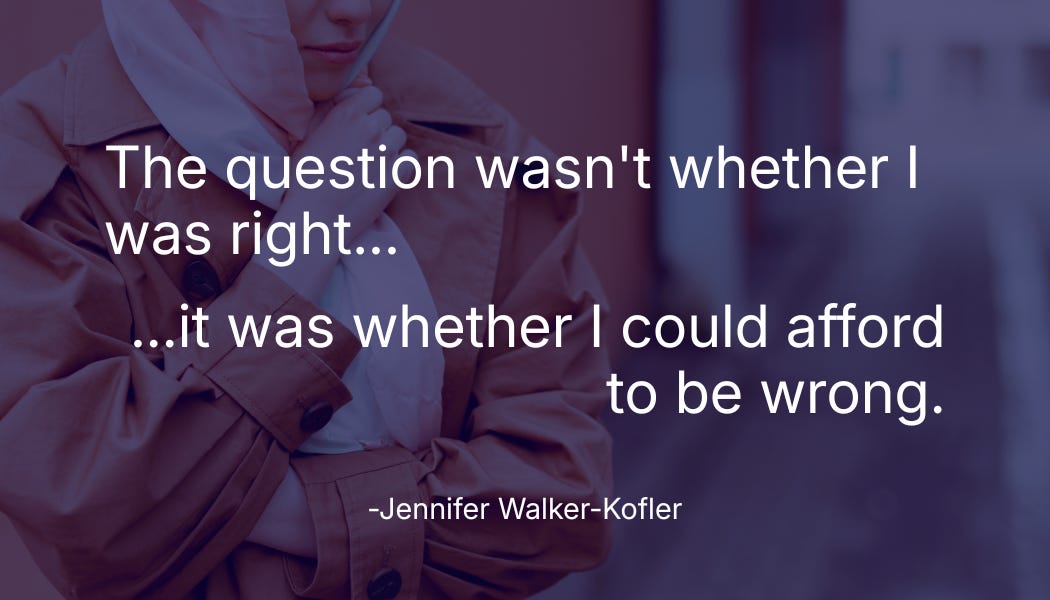
This is where risk assessment enters the picture. When assessing a threat, probability matters. But so does consequence.
If Jenny is wrong, an innocent man could lose his position because she deliberately engineered a situation against him.
But what if she’s right?
What would it cost her to wait until she had irrefutable proof? And what would “proof” actually look like?
Would she have to wait until she was drugged, restrained, trafficked, or otherwise placed in a situation where the threat was no longer theoretical? Would proof arrive only after something irreversible had already happened?
For Jenny, those possibilities aren’t abstract. She is well aware of the darker side of humanity and has seen firsthand what can be left of the people who didn’t survive it.
She is the person who will bear the consequences if her assessment is wrong—or if she is right and does nothing.
So she decides to act before she has certainty. But notice what she actually does.
She doesn’t report the guard.
She doesn’t confront him.
She doesn’t ask someone else to intervene.
She gives Yanis information that serves his own criminal interests and creates an opportunity for him to exploit an existing vulnerability in the guard’s behavior. She also makes sure she has another plan if Yanis decides not to participate.
That’s not exactly innocent. But does that make it wrong?
Or is this what self-protection looks like when the people and systems you’re supposed to be able to rely on aren’t capable of protecting you fast enough?
Let’s ask another question
If Jenny had waited for proof and something irreversible happened to her, would we judge her differently for failing to act sooner?
I don’t think there’s an easy answer. I’m not sure there should be.
Was Jenny defending herself?
Was she justified in acting on suspicion?
Did she cross a line by discussing cooperation with Yanis?
What if it were you instead of Jenny?
How much certainty would you require before taking action if the cost of waiting could be irreversible?
So what was the outcome?
It would be quite mean of me to leave you hanging. So here is the excerpt from the outcome:
Yanis POV
Jenny’s plan yesterday had paid off. Despite the unexpected involvement of the Russians and the Roma, I now possessed a master key safely hidden in an obscure nook of the facility. It was shaping up to be a nice weekend—I just needed to get away from this disgusting place and Samir’s constant coughing.
“Dominic can’t keep touching me like he does.” Jenny pouted to the Chief of Security as she made her way ahead of me through the security checkpoint. “It makes me really uncomfortable.”
“I’m sorry, Dominic did what now?” the Chief asked, his face darkening as Jenny repeated her complaint. “Would you mind stepping into the conference room with me for a moment,” he asked Jenny and her parents.
The Roma family ahead of me exchanged glances, carefully avoiding looking at me. We had all played a part in what went down yesterday. It had gotten somewhat out of hand. Dominic had spent over an hour retrieving parts of his uniform shirt, belt, and tactical items. What he hadn’t recovered were his keys, most of which had fallen into a floor drain—with my help, of course.
I suppressed a grin. Jenny had been right when she said it would be fun. Watching Dominic endure the humiliation, anger, and panic of chasing down his gear had been intensely satisfying.
Such a risky operation. And yet it worked.
I handed my ID to the guard at the checkpoint. Through the glass partitions of the guardhouse, I could see Jenny crying. Her parents and security were trying to console her.
Adding the final nails to Dominic’s coffin. Girl isn’t leaving anything to chance.
Now the question gets harder.
Jenny never actually acts against Dominic herself.
She identified a vulnerability.
She identified someone (Yanis) capable of exploiting it.
She gives Yanis the information needed to exploit the vulnerability.
She identified a time and place when the only witnesses were individuals that had been negatively affected by this particular guard’s petty aggression.
And then she steps back.
The opportunity already existed. The protocol violation was already there. Yanis already understood Jenny’s objective and had offered to help. Jenny simply recognized that his interests and hers could temporarily align.
And the result?
The guard is compromised.
Jenny’s immediate problem is reduced. Yanis gets something he wants. And yet we still don’t know whether Jenny was right about the thing that started all of this.
She suspected Dominic was connected to the trafficking operation, but she acted without proof.
Which brings us to the larger question:
If you identify a vulnerability that someone else can exploit, and tip off the right person in the right place already looking to exploit it, how different are you from the person who actually does the exploiting?
So, what’s your take?
Was Jenny protecting herself—or manipulating circumstances to punish someone she suspected might be dangerous?
Does the fact that she never personally acted against Dominic change your judgment?
And if you were the person who had to live with the consequences of being wrong, how much certainty would you require before acting?
Play devil’s advocate. Take the position you disagree with. Challenge Jenny’s reasoning. Challenge mine. Let’s examine the situation from as many angles as possible.
Drop your thoughts in the comments below. The conversation is open to subscribers, so this is our little corner of the filing room.
And one last thing before you go…
Remember to download your exclusive copy of Downward Spiral, the prologue to Roots of Obsession.
If you’re not subscribed to The Kofler Files yet, click the Subscribe button below, and you’ll get instant access to Downward Spiral, the exclusive prologue to Roots of Obsession.
Thanks for reading! Subscribe for a free monthly newsletter from psychological espionage fiction writer J. W. Kofler, exploring manipulation, deception, identity, and the lives of those adjacent to espionage.
Just read the prologue.. quite entertaining… not sure what to think of Yanis.. of course would need to read more to draw a conclusion.. is he the good guy or misunderstood or a typical control freak who needs to be in control of everything around him?




Just read the prologue.. quite entertaining… not sure what to think of Yanis.. of course would need to read more to draw a conclusion.. is he the good guy or misunderstood or a typical control freak who needs to be in control of everything around him?
My upcoming book, Roots of Obsession, will provide some answers...😎